My response to that Vogue article
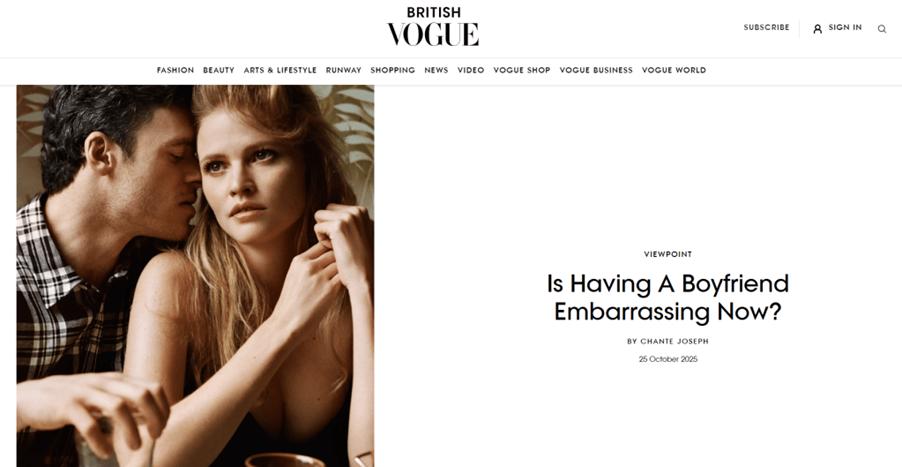
The Vogue article asking whether it is “embarrassing to have a boyfriend” struck a nerve, even months later, not because it revealed a hidden truth, but because it misidentified the problem. Having a boyfriend is not embarrassing. Wanting love, partnership, intimacy, hasn’t suddenly become shameful, unimportant or “Republican”. What has changed is the cultural framework we use to understand ourselves and each other.
Young adults are navigating economic uncertainty, career precarity, and social pressures: being settled on a clear trajectory is hard to pin down. So instead, appearing ambitious, fun, and independent seems more in reach. In this environment, having a boyfriend can sometimes signal domesticity, which conflicts with the performative image of carefree independence that peers often value because that was the option available when security wasn’t. And, perhaps we all just want to be in it together, whatever ‘it’ is.
When 25-year-olds are still living at home, and 30-year-olds are in flat shares, hearing the words ‘my boyfriend’ doesn’t really resonate, and can make people wary of the future.
For a long time, romantic partnership functioned as a kind of social shorthand for women. Finding a boyfriend, getting married, and settling down were milestones that signalled success, stability, and desirability. They weren’t just personal achievements; they were social positioning. A woman’s relationship status told the world who she was, where she was going, and whether she was “on track.” But that framework no longer holds the same power.
Think of Bridget Jones at her dinner parties, sitting between four friends with their perfect partners, being quizzed about her love life. Imagine this today: friends catching up, discussing job searches, graduate schemes, the rental market, and fawning over the select few who managed to secure positions, or houses, barely a mention of a boyfriend.
Similarly, contemporary expectations have shifted. Many women today are encouraged, both socially and economically, to prioritise self-development: travelling, collecting experiences, building a meaningful career, or at least the appearance of one. As a result, personal worth is less often measured through romantic attachment and more through independence and ambition. The once-routine question, “Do you have a boyfriend?”, is increasingly replaced by “What do you do?” This reflects a broader redefinition of success and adulthood, one in which a woman’s sense of self is no longer expected to orbit around partnership, but around her own aspirations and agency.
This shift also exposes a long-standing double standard. Men were rarely asked, “Do you have a girlfriend?” unless the question was flirtatious or incidental. Their value was assumed to lie elsewhere. Men had jobs, houses, ambitions, holidays; tangible markers of progress that society deemed more legitimate, more interesting, and more appropriate topics of conversation. Women, by contrast, were often reduced to their relationship status, as though partnership was the primary evidence of a life going well.
What we are witnessing now is a levelling of that terrain. Women are increasingly assessed through the same metrics: work, ambition, momentum, and independence. In that context, returning to boyfriend talk can feel not regressive exactly, but oddly beside the point. Not because love is trivial, but because it no longer performs the social function it once did.
Historically, romantic partnership, particularly heterosexual partnership, was framed as the end goal for women. Economic independence for women was limited, career paths were narrower, and social legitimacy was often tied to being chosen by a man. Love and security were bundled together, and a boyfriend or husband represented both.
In that context, asking a woman whether she had a partner made sense. It efficiently signalled social position. Was she settled? Respectable? Successful by societal standards?
This existed alongside a relatively stable economic backdrop. Jobs, especially entry-level, were more accessible. Starting life after education was plausible. Work was attainable and structured.
Today, stability has eroded. In the UK, entry-level jobs are harder to secure. Graduates compete for roles demanding years of experience, unpaid internships are normalised, and industries feel inaccessible without connections or capital. Work is no longer a guaranteed next step but a prolonged state of limbo or a handy measure of success.
As a result, work has become the new social shorthand.
The easiest way to ask someone about themselves now is not “Are you seeing anyone?” but “What do you do?” “How’s the job search going?” or “Why did you decide to travel?” These questions locate someone within a fractured economic system. Are they coping, succeeding, or opting out?
In this context, relationships lose their role as the primary indicator of adulthood or success. Not because they matter less, but because they no longer answer the most pressing question: how are you surviving this cultural landscape?
Having a boyfriend can now feel like a minor setback. To project the right image, ambitious, fun, carefree, aligns with the unstable vibes of contemporary adulthood. Back then, everything was more certain, and a boyfriend could act as the final block to a perfectly harmonious life; now, he may temper the narrative of unpredictability that young adults are expected to embody.
It’s not about having an embarrassing boyfriend; it’s about what a boyfriend doesn’t explain anymore.
A partner does not clarify your financial future. It doesn’t guarantee housing, stability, or purpose. Posting a relationship online can feel insufficient when so much else is unresolved. Against economic anxiety, climate collapse, and professional precarity, romance can seem small, not because it is, but because it cannot solve structural problems.
There is a quiet fear of appearing complacent. Publicly centring a relationship can look like opting out of ambition or complexity, especially for women who are still expected to prove independence, drive, and self-sufficiency. The embarrassment isn’t about love, it’s about being seen as settled in a world that demands constant striving.
The Vogue question went viral because it frames a cultural shift as a personal failing. It suggests that people are ashamed of relationships, when in reality, I believe, they are disoriented by a world where traditional markers of progress no longer align.
Love hasn’t lost its value. What’s changed is that it no longer functions as social proof.
We are living through a moment where identity is increasingly built around labour, or the lack of it. Where careers are unstable, futures are deferred, and adulthood feels permanently postponed. In that landscape, a boyfriend is neither embarrassing nor impressive. He is simply no longer the answer to the question everyone is asking.
Perhaps the real issue is not whether it’s embarrassing to have a boyfriend, but why we are still looking for single data points to summarise entire lives.
Asking someone about their job, their relationship, or their five-year plan is often an attempt to impose order on chaos. But the chaos is structural, not personal. No boyfriend, no job title, no curated narrative can fully explain what it means to be young right now.
If we want more honest conversations, we might need better questions, ones that acknowledge uncertainty rather than trying to resolve it. Until then, love will continue to be misread, not because it’s embarrassing, but because it no longer carries the explanatory power it once did. But if you are in a happy relationship, then you have support, love, and happiness to guide you through these tumultuous times!
 BEYOND THE WORD