Travel is often conceived as a forward motion: a restless pursuit of the new, the novel and the unknown. It promises escape from the familiar, offers distraction through difference, and invites discovery of the unexpected. However, some places resist this current. They do not simply allow the traveler to pass through; they ask for pause and for presence. They demand to be witnessed, not consumed. Budapest is one such place.
On the surface, Budapest offers all the familiar pleasures of a European city break. Affordable flights, modest accommodation, cheap beer and hearty food. The city is aesthetically rich, offering a skyline defined by golden domes, ornate spires, and distant hills that rise gently beyond the Danube – a visual landscape that captures both grandeur and grace. Yet beneath this accessible charm lies a deeper current. Budapest is a city that holds memory close to the surface. It is not a curated past displayed behind glass, but a living memory, embedded into the very fabric of daily life. Architecture, monuments, and even the spaces between buildings speak to histories that remain unresolved, ongoing.
The city’s geography mirrors its psychological structure. Divided into Buda and Pest by the Danube River, Budapest carries dualities within itself, eastern and western, old and new, joyful and solemn. The grandeur of St. Stephen’s Basilica, the lively terraces of the Intermezzo Sky Bar, and the festive atmosphere of river cruises coexist with the quiet gravity of memorials and scars from war, occupation, and resistance.
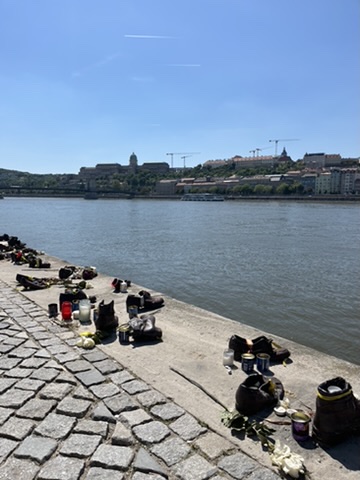
Few places illustrate this contrast as starkly as the Shoes on the Danube Bank. This installation, consisting of iron shoes permanently affixed to the river’s edge, commemorates Hungarian Jews who were executed during the Second World War. Ordered to remove their shoes before being shot into the river, their absence is marked not with words, but with objects – mute, ordinary, devastating in their stillness. The monument is not didactic. It does not explain. It insists on presence and reflection.
In cities like Budapest, memory is not passive. It functions as a formative force – shaping identity not only for those who live within its limits, but also for those who pass through with eyes open to its complexity. This is a city that remembers publicly, insistently. And in doing so, it challenges the often superficial nature of tourism. Here, travel becomes less about consumption and more about engagement. The past is not an aesthetic, it is a presence.
This presence calls into question the role of the traveler. In places marked so clearly by suffering and survival, the visitor is no longer merely an observer. To walk the streets of Budapest attentively is to enter into a relationship with history. Not a neutral or nostalgic history, but one that continues to define identity: national and individual, inherited and evolving.
Memory and identity, in this context, are not abstract concepts. They are material realities. They are the tension between celebration and mourning, between a cocktail enjoyed on a rooftop and a moment of silence by the river. They are seen in the layering of centuries within a single block: Ottoman baths, Habsburg grandeur, Communist architecture, contemporary cafés. Each layer speaks to a different vision of the city, a different version of self.
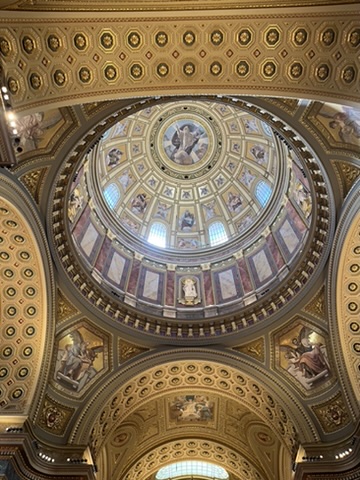

Budapest does not resolve these contradictions. It holds them. And in doing so, it offers a model for thinking about identity that is not linear but layered, not fixed but in motion. Identity, like memory, is plural, shaped by what is remembered and by the manner in which remembrance occurs.
In the end, Budapest offers more than a destination. It offers an encounter with a city that refuses amnesia, and with the question of what it means to carry the past forward. Travel here is not simply movement through space, but an invitation to reckon with time. And in that reckoning, something rare emerges: the possibility of being changed not by what is seen, but by what is understood.
 BEYOND THE WORD